
The Palestinian Constitution

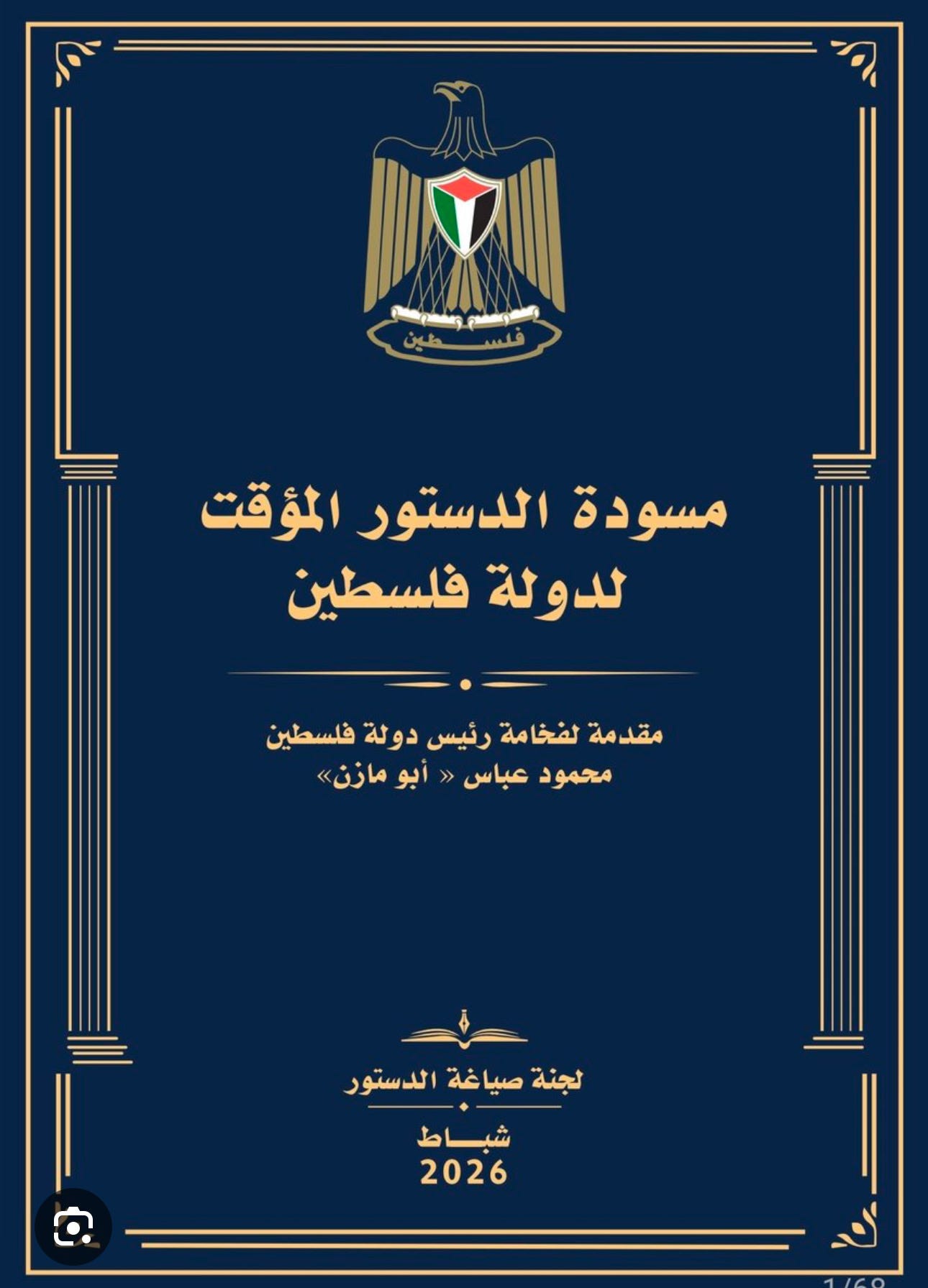
It began, as these things often do, with a letter.
On June 9, 2025, Mahmoud Abbas wrote to Emmanuel Macron. In it, the president of the Palestinian Authority offered solemn assurances: a condemnation of October 7, support for Hamas’s disarmament, the exclusion of Hamas from any future governance, a commitment to combat incitement, and a pledge to reform Palestinian institutions. Paris made the letter public. So did the Élysée.
On July 24, Macron responded. He said he was “honored” by Abbas’s commitments. He announced that France would recognize the State of Palestine at the United Nations in September.
On September 22, from the podium of the U.N. General Assembly, Macron made good on that promise. He cited Abbas’s written guarantees and declared that France would be “attentive to the full implementation of each commitment made to it.” Recognition, he insisted, was not unconditional. It was tied to specific undertakings.
None of them were kept.
On November 11, Abbas was received at the Élysée for his first official visit since recognition. Macron praised him as a “partner for peace” and commended his “consistent rejection of terrorism.” In return came more pledges—the same as in June, repackaged with added solemnity. One stood out: the definitive end of the so-called “Pay for Slay” program, under which the Palestinian Authority provides monthly stipends to imprisoned terrorists and the families of those killed while carrying out attacks against Israeli civilians.
In September, French Foreign Minister Jean-Noël Barrot had triumphantly declared the program “finished.” Within weeks it became clear that the payments had simply been restructured and renamed. The money kept flowing.
Still, Abbas promised again. And France promised in return: €100 million in aid, plus technical assistance to draft the future Palestinian constitution. A joint Franco-Palestinian committee was announced with considerable fanfare.
On February 10, 2026, the Palestinian draft constitution was published.
Here is what it contains.
Article XXIV imposes a constitutional obligation on the Palestinian state to “protect and care for the families of the martyrs, the wounded, and the prisoners.” In the Palestinian Authority’s terminology, “martyrs” and “prisoners” include perpetrators of terrorist attacks against Israeli civilians. “Pay for Slay” has not been abolished. It has been constitutionalized. Any future government seeking to end it would need a constitutional amendment subject to referendum.
Abbas promised Macron he would dismantle the system. Instead, he enshrined it.
Then there is what the constitution does not say.
As constitutional scholar Zaid Al-Ali has noted, in its 162 articles the word “Jews” does not appear once. Nor does “Israel.” Christians are explicitly mentioned and protected. Jerusalem is designated the Palestinian capital, with its Islamic and Christian dimensions recognized. The millennia-old Jewish presence in the city—its holy sites, its history, its sacred geography—is absent. Article 4 designates Islamic sharia as “a principal source of legislation.” The “right of return” is declared inalienable, formulated without territorial limitation—widely interpreted to mean a return not only to a future Palestinian state, but to Israel itself, a demographic formula that would end Israel as a Jewish state.
But the most consequential provision lies deeper.
The preamble asserts, as a foundational premise—not as an allegation but as fact—that “the genocide continues in the Gaza Strip and the West Bank.” Present tense. Constitutional truth. Article XXIV obligates the state to pursue “the perpetrators of these crimes before justice.” Article 69 declares such crimes imprescriptible and forbids pardon or amnesty. Article 156 bars amendment of fundamental rights provisions.
Follow the logic.
If genocide is constitutionally defined as ongoing in Gaza and the West Bank, then Israel is, by definition, a genocidal state. The Palestinian government is constitutionally required to pursue its leaders. Those claims cannot be time-barred. They cannot be forgiven. They cannot be amended away.
Any Palestinian leader who agreed, in the context of a peace deal, to waive such prosecutions would violate his own constitution.
This is not rhetoric. It is a permanent legal lock on any future peace architecture. France helped finance the drafting of a document that makes reconciliation constitutionally impossible.
Diplomacy often requires a suspension of disbelief. States accept fragile promises in the hope that movement creates momentum. Sometimes that gamble pays off. But not here. Not with this Palestinian Authority.
We knew who Abbas was. Elected in 2005 for a four-year term, he has now ruled for more than two decades without a national election. We knew that “Pay for Slay” had survived every reform pledge of the past twenty years. We knew that Palestinian textbooks routinely erase Israel and traffic in antisemitic tropes. None of this was secret.
And yet French diplomacy chose to believe the June 9 letter.
What happened here is less naïveté than comfortable capitulation. Recognizing Palestine was politically expedient and morally flattering. The conditions provided plausible deniability: if things went wrong, Paris could say it had demanded guarantees. But the decision preceded the letter. Abbas understood that. That is why he wrote it.
So now what?
France has granted recognition. It has pledged €100 million. It publicly vouched for Palestinian good faith. And the commitments on which that recognition was based have been repudiated—line by line—in the very constitution France helped midwife.
The silence from the Quai d’Orsay since the document’s publication speaks volumes.
This is not about defending Israel or denying Palestinian suffering. Palestinian suffering is real. So is Israeli fear. This is about coherence—and about a habit of mind that might be called the bigotry of low expectations: the assumption that Palestinians cannot be held to the standards we would demand of any other national movement. Not on terrorism. Not on incitement. Not on UNRWA. Not on constitutional commitments.
That indulgence is not compassion. It is condescension. And it has not brought peace any closer. One can only hope that France and other nations are expressing their opposition clear at least privately.
If anything, this constitution would entrench a status quo that rewards maximalism and punishes compromise—while Western governments congratulate themselves for their moral clarity.
That means we have learned nothing.
That is what this constitution says.
We can't ever expect much from the country of the Dreyfus affair, a Vichy Government that sided with the Nazis, the country that burned copies of the Talmud and other holy books! A shameful history continues! The tiger that never changes its stripes is an apt saying, but the French are not tigers, but it rather sports a yellow streak of cowardice! Surrender is one of their key imperatives, evidenced by their cozying up with evil! Their country has become dangerous for Jews, and soon probably for Christians as well. So France, run a sale on prayer rugs because Sharia is quickly approaching!
Well articulated and very damning towards France, which is avidly reaping its reward of embracing the Islamic ummah while joining it shortly.